
The Largest Pension Fund in the World: Top 20 Ranking (2026)

Index
The world's largest pension funds collectively manage assets on a scale that dwarfs most national economies. At the top of the global ranking sits Norway's Government Pension Fund Global, which crossed the historic $2 trillion mark in assets under management in 2025 — and reached $2.049 trillion by May 2026, cementing its position as not only the largest pension fund in the world, but the largest sovereign wealth fund of any kind.
This guide covers the 20 largest pension funds globally, what they manage, where they invest, and what the trends in this sector mean for pension investors in the UK and beyond.
How is the ranking compiled?
The data in this article draws primarily from the Global Top 300 Pension Funds report, compiled by the Thinking Ahead Institute of WTW in collaboration with Pensions & Investments magazine — the most authoritative annual ranking of institutional pension assets worldwide. Asset figures are updated with the most recently available public data for 2025/26.
The report covers the world's 300 largest pension funds and tracks total assets under management (AUM), fund type, geography, and growth trends. The 2025 edition found that the top 300 funds together managed a record $24.4 trillion in assets at end-2024 — surpassing the previous record of $23.6 trillion set in 2021 before the 2022 market correction.
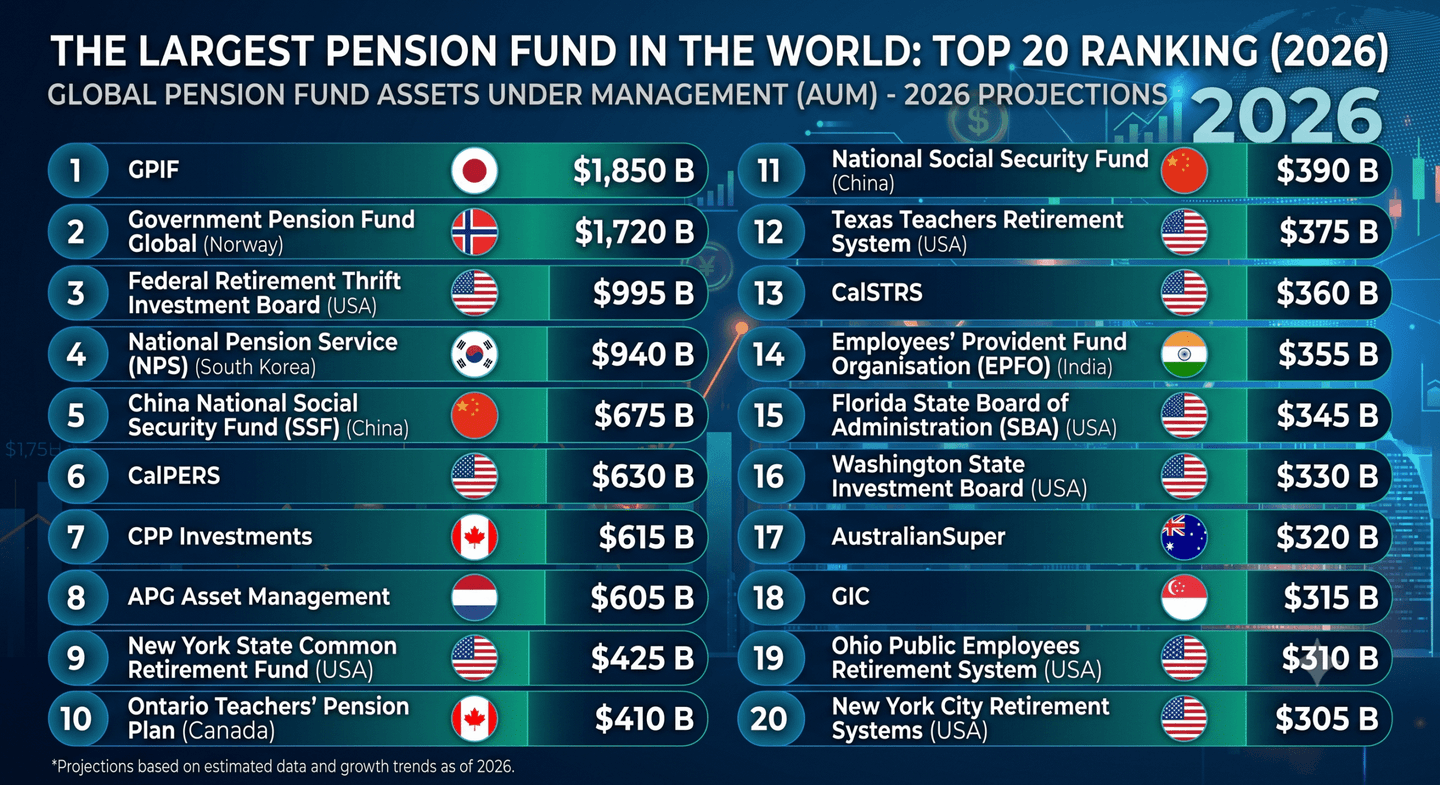
The 20 largest pension funds in the world (2025/26)
The figures below are sourced from the Thinking Ahead Institute (September 2025) and updated with the most recently available public data. Assets are shown in millions of US dollars.
| # | Pension Fund | Country | Total Assets (USD millions) |
|---|---|---|---|
| 1 | Government Pension Fund Global | 🇳🇴 Norway | 2,049,000* |
| 2 | Government Pension Investment Fund (GPIF) | 🇯🇵 Japan | 1,645,550 |
| 3 | Federal Retirement Savings Investment Board (TSP) | 🇺🇸 USA | 954,255 |
| 4 | National Pension Service | 🇰🇷 South Korea | 820,799 |
| 5 | ABP | 🇳🇱 Netherlands | 560,056 |
| 6 | CalPERS | 🇺🇸 USA | 541,965 |
| 7 | CPP Investments | 🇨🇦 Canada | 496,935 |
| 8 | Central Provident Fund | 🇸🇬 Singapore | 446,248 |
| 9 | National Social Security Fund | 🇨🇳 China | 366,747 |
| 10 | CalSTRS | 🇺🇸 USA | 354,170 |
| 11 | New York City Retirement Systems | 🇺🇸 USA | 285,522 |
| 12 | Employees Provident Fund | 🇲🇾 Malaysia | 279,435 |
| 13 | New York State Common Retirement Fund | 🇺🇸 USA | 274,682 |
| 14 | PFZW | 🇳🇱 Netherlands | 267,714 |
| 15 | Local Government Officials Pension Fund | 🇯🇵 Japan | 232,587 |
| 16 | Florida State Board of Administration | 🇺🇸 USA | 223,480 |
| 17 | AustralianSuper | 🇦🇺 Australia | 212,376 |
| 18 | Teacher Retirement System of Texas | 🇺🇸 USA | 211,611 |
| 19 | Employees' Provident Fund Organisation (EPFO) | 🇮🇳 India | 199,447 |
| 20 | Labor Pension Fund | 🇹🇼 Taiwan | 197,205 |
*Norway figure updated to May 2026 (source: Norges Bank Investment Management). All other figures from Thinking Ahead Institute, September 2025. Exchange rate fluctuations mean rankings can shift between reporting dates.
The largest pension fund in the world: Norway's Government Pension Fund Global
Norway's Government Pension Fund Global — colloquially known as the Oil Fund (Oljefondet) — is in a league of its own. The fund reported a return of around 1.4 trillion Norwegian kroner in 2025, bringing its total value to 21.27 trillion kroner. As of May 2026, it had over $2 trillion in assets, equal to approximately 1.5% of the value of all the world's listed companies — making it the world's largest sovereign wealth fund in terms of total assets under management, at over $390,000 per Norwegian citizen.
The fund was established in 1990 to invest the surplus revenues from Norway's petroleum sector. It is managed by Norges Bank Investment Management (NBIM) on behalf of the Norwegian population, with strict ethical guidelines governing all investment decisions — companies can be excluded for environmental damage, corruption, or human rights violations.
Key facts about the Norwegian Government Pension Fund Global:
- AUM: ~$2.049 trillion (May 2026)
- Asset allocation: ~71% equities, ~27% fixed income, ~2% real estate and renewable energy infrastructure
- Holdings: Shares in approximately 7,200 companies worldwide
- Average annual return: 6.64% since inception
- 2025 renewable energy infrastructure return: 18.1%
- Managed by: Norges Bank Investment Management (NBIM), a division of Norway's central bank
Notably, despite its name, the Government Pension Fund Global has nothing to do with pensions in the traditional sense. It is a sovereign wealth fund that invests oil revenues for the benefit of future generations — the "pension" in its name refers to the fund's long-term savings purpose, not a direct pension obligation to individual citizens.
Key trends in global pension fund management
Record assets and increasing concentration at the top
The world's top 300 pension funds reached a record $24.4 trillion in assets at end-2024 — surpassing the previous peak of $23.6 trillion set in 2021. Growth moderated slightly: assets grew 7.8% in 2024, compared with 10% in 2023.
Concentration at the top is accelerating. For the first time, the 20 largest funds together manage over $10.3 trillion — representing 42.4% of total Top 300 assets. This subgroup grew 8.5% year-on-year, outpacing the broader ranking.
Defined benefit vs defined contribution
Defined benefit (DB) schemes remain dominant, accounting for 59.4% of total disclosed assets — though this is the first time their share has fallen below 60%. Meanwhile, defined contribution (DC) plans grew faster in 2024, increasing 14.3% year-on-year and now representing 27.7% of total assets.
This structural shift mirrors what has happened in the UK over the past two decades, where employer DB pension schemes have been largely replaced by workplace DC auto-enrolment schemes. The shift places more investment decision-making responsibility on individual savers.
Technology, AI, and geopolitical risk
Large pension funds are increasingly focusing on technology and artificial intelligence, with several institutions strengthening their AI expertise and adopting technological solutions in portfolio management. At the same time, market volatility, geopolitical uncertainty, and inflation remain among the main concerns shaping the outlook for global pension investors.
What does this mean for UK pension savers?
Understanding global pension fund structures provides useful context for UK savers managing their own retirement savings. A few key takeaways:
- Diversification across asset classes: The largest funds in the world — including Norway's Oil Fund — hold a mix of equities (~71%), bonds (~27%), and real assets such as property and infrastructure. This broadly mirrors the multi-asset approach recommended for UK defined contribution savers in the accumulation phase.
- Long-term perspective pays off: The Norwegian fund's 6.64% average annual return over decades demonstrates the power of a long investment horizon and disciplined asset allocation — principles equally applicable to a UK Stocks and Shares ISA or SIPP.
- Cost matters enormously: The largest funds benefit from economies of scale that dramatically reduce management costs. UK savers should similarly prioritise low-cost index funds and platforms — even small fee differences compound significantly over decades.
- The shift from DB to DC: The global decline of defined benefit pensions places more responsibility on individual savers. UK workers today are largely in DC auto-enrolment schemes rather than guaranteed DB pensions — making understanding investment choices and contribution levels more important than ever.
FAQs
What is the largest pension fund in the world?
The Government Pension Fund Global of Norway is the largest pension fund (and sovereign wealth fund) in the world, with assets under management of approximately $2.049 trillion as of May 2026. It overtook Japan's Government Pension Investment Fund (GPIF) — which had held the top spot for more than two decades — and has since extended its lead significantly. The fund holds over $390,000 per Norwegian citizen and represents approximately 1.5% of all the world's listed companies.
What is the largest pension fund in the UK?
The largest pension fund in the UK is the Universities Superannuation Scheme (USS), with over £90 billion in assets. The Local Government Pension Scheme (LGPS) — which covers local authority workers across England and Wales — is also among the largest, with total assets exceeding £380 billion across its various pools. Neither appears in the global Top 20, reflecting the scale difference between even the largest UK funds and the dominant US, Norwegian, and Japanese institutions.
How does Norway's pension fund make money?
Norway's Government Pension Fund Global invests approximately 71% of assets in equities, 27% in fixed income, and 2% in real estate and renewable energy infrastructure. It holds shares in around 7,200 companies across most global markets. The fund achieves an average annual return of 6.64%, and renewable energy infrastructure investments returned an above-average 18% by 2025.
Which country has the most pension funds in the global Top 20?
The United States dominates with 7 funds in the Top 20: the TSP (Federal Thrift Savings Plan), CalPERS, CalSTRS, New York City Retirement Systems, New York State Common Retirement Fund, Florida State Board of Administration, and the Teacher Retirement System of Texas. The Netherlands has 2 (ABP and PFZW), Japan has 2 (GPIF and the Local Government Officials fund), and Norway, South Korea, Singapore, China, Canada, Malaysia, Australia, India, and Taiwan each have 1.
What is the difference between a pension fund and a sovereign wealth fund?
A pension fund holds assets to meet future pension obligations to specific beneficiaries — employees, retirees, or public sector workers. A sovereign wealth fund is a state-owned investment vehicle that manages national savings or resource revenues for long-term national benefit, without specific individual beneficiaries. Norway's Government Pension Fund Global is technically a sovereign wealth fund — despite its name, it has no direct pension obligation to individual citizens. It is ranked alongside pension funds in global comparisons because of its scale and long-term investment mandate.
How do global pension funds invest?
The world's largest pension funds typically allocate across multiple asset classes: equities (typically 50–70%), fixed income/bonds (20–35%), and real assets including property, infrastructure, and private equity (5–15%). Many are increasingly investing in technology, renewable energy, and private markets. Defined benefit funds tend to hold more bonds (to match long-term liabilities), while defined contribution funds often skew more heavily toward equities, particularly during the accumulation phase.
This article is for informational purposes only and does not constitute financial advice. All figures are subject to change as markets move and official data is updated.